

Trout Gear
Fly fishing for trout in South Africa offers anglers remarkable diversity across pristine mountain streams, productive stillwaters and challenging farm dams. From the crystal-clear Drakensberg rivers to Rhodes' legendary Wild Trout Association waters, the Western Cape's technical streams and Mpumalanga's stillwaters, success demands matching gear to conditions. Rainbow and brown trout thrive across these varied environments, with fish averaging 1-3kg in stillwaters and wild stream fish offering technical challenges in ultra-clear water.
Stream fishing requires precision and stealth with delicate presentations, whilst stillwater demands distance casting and depth control. Trout behaviour shifts with habitat—stream fish hold in feeding lanes, whilst stillwater trout cruise actively hunting. Highland venues like Dullstroom and the Drakensberg demand proper layering for rapid weather changes, whilst lower altitude Western Cape streams allow comfortable wet wading most of the year.
The traditional season runs March through October, with autumn (March-May) and spring (September-October) delivering peak conditions. Winter brings spawning closures on Drakensberg and Western Cape rivers, though Rhodes rivers remain open and stillwaters (dams, lakes, ponds) stay accessible year-round. Summer provides excellent dry fly action during morning and evening rises.
This guide covers essential trout gear from rods through waders, flies and accessories. We detail stream-specific versus stillwater requirements, address the nylon versus fluorocarbon debate, and provide recommendations across multiple price points.
In This Gear Guide
- Fly Rods
- Fly Reels
- Fly Lines
- Leaders & Tippet
- Clothing & Sun Protection
- Bags, Packs & Vests
- Boots & Waders
- Accessories & Tools
- Fishing Flies – Freshwater
- Float Tubing
- Frequently Asked Questions

Fly Rods
A 9-foot rod in the 3-6 weight range suits South African trout fishing. Stream anglers favour 3-4 weights for delicate presentations, offering precise casting in tight quarters. Stillwater demands 5-6 weights providing power for distance casting through wind. The 5-weight represents versatile middle ground. Fast-action rods excel in stillwater where wind-cutting matters, whilst medium-fast actions suit stream work balancing delicacy with power.
Four-piece travel designs ease transport to remote venues. Quality graphite construction provides sensitivity for detecting subtle takes. Consider rods with fighting butts for stillwater trophy fish.
Recommended Specifications:
- Line weight: 3-4 weight for streams, 5-6 weight for stillwater, 5 weight for versatility
- Length: 9 feet standard, 7.5-8.5 feet for overgrown streams
- Action: Fast for stillwater/wind, medium-fast for streams
- Features: 4-piece travel design

Fly Reels
South African trout make spirited runs demanding smooth, reliable drag systems. Stillwater fish reach 1-3kg regularly, with trophies exceeding 4.5kg at specialist venues. Large arbor reels retrieve line faster and reduce line memory. Sealed or semi-sealed drags protect against moisture and grit, critical when float tubing. Match reel size to rod weight—3/4 for streams, 5/6 for stillwater.
Quality machined aluminium construction ensures longevity. Balance between rod and reel improves casting comfort. Budget R4,000-R7,000 for reliable performance.
Recommended Specifications:
- Size: 3/4 for stream rods, 5/6 for stillwater
- Drag: Sealed/semi-sealed disc, 1-2kg for streams, 2-3kg for stillwater
- Arbor: Large arbor design
- Construction: Machined aluminium
- Backing capacity: 50-100m (stream), 100-150m (stillwater), 20lb test

Fly Lines
Weight-forward floating lines serve as primary workhorses. This taper loads rods quickly, delivers distance and handles dry flies to weighted nymphs. Cold-water formulations stay supple in highland conditions. A premium floating line represents the most important investment after rod and reel.
Depth versatility demands additional types. Intermediate lines fish just below surface without spooking stillwater fish. Full sinking lines (type 3-6) probe deeper water. Sonar Leaders attach to floating lines providing nymphing depth without full line changes.
Recommended Specifications:
- Taper: Weight-forward (primary), double-taper for stream delicacy
- Type: Floating primary, intermediate and sinking secondary
- Weight: Match to rod (3-6 weight range)
- Coating: Cold-water formula for SA highland conditions

Leaders & Tippet
Stream fishing demands 9-12 foot leaders terminating in 4X-6X tippets, with 5X (2.5kg) as the sweet spot. Ultra-clear water requires 7X. Stillwater allows 3X-4X (2-4kg), with 5X for technical presentations. Independent testing reveals nylon monofilament provides equal or better abrasion resistance compared to fluorocarbon at equivalent breaking strengths.
Use nylon for dry fly fishing. Use fluorocarbon for nymphing where low visibility (refractive index 1.4 matches water at 1.33) and faster sink rate matter.
Recommended Specifications:
- Leader length: 9-12 feet for streams and stillwater
- Tippet strength: 4X-7X for streams (5X at 2.5kg), 3X-5X for stillwater (4X at 3kg)
- Material: Nylon for dry flies, fluorocarbon for subsurface
- Note: Carry multiple strengths

Clothing & Sun Protection
South African trout waters span altitude from sea level to 3,000m peaks, demanding versatile clothing. Start with a comfortable long-sleeve sun shirt with UPF 50+ protection. Add a lightweight fleece for cooler conditions and a waterproof-breathable rain jacket for weather changes. In very cold environments, use a merino wool base layer (200-260gsm) under your fleece. Quick-dry fishing pants or convertible trousers offer versatility. For detailed guidance on proper layering systems, see our [Layering and Wader Care guide](/pages/layering-and-wader-care).
Sun protection matters critically on stillwaters where reflection intensifies UV exposure. Wide-brimmed hats shade face and neck. Polarised sunglasses with copper or amber lenses cut glare whilst revealing fish—UV 400 protection prevents eye damage.
Recommended Items:
- Sun hoody with UPF 50+ protection OR long-sleeve button-down shirt
Lightweight fleece for cooler conditions - Waterproof-breathable rain jacket
Base layer for very cold: Merino wool (200-260gsm) - Quick-dry fishing pants or convertible trousers
- Wide-brimmed hat with neck protection
- Polarised sunglasses (copper/amber lenses, UV 400)
- Buff or neck gaiter

Bags, Packs & Vests
Organisation efficiency directly impacts fishing productivity. Vest packs suit stream fishing providing accessible storage, whilst chest packs work excellently for both streams and stillwater float tubing. Modern packs incorporate water-resistant materials protecting fly boxes and electronics. Multiple compartments allow systematic organisation.
Look for D-rings and retractor mounts for tools needing instant accessibility. Size should accommodate 2-4 fly boxes, leader wallet and accessories without becoming cumbersome.
Recommended Features:
- Water-resistant material (IPX4 minimum)
- Multiple compartments for systematic organisation
- Tool attachment points (D-rings, retractor mounts)
- Comfortable harness/straps for all-day wear
- Style: Vest pack or chest pack for streams, chest pack for float tubing

Boots & Waders
South African trout fishing divides into wet wading (October through May) and cold-water wading seasons (June through early October). Wet wading allows comfortable fishing with specialised boots and neoprene socks. Rubber-studded wading boots provide excellent traction whilst staying clean on trails—critical for biosecurity. Ankle support proves essential navigating uneven streambeds.
Cooler months demand breathable chest waders, particularly in highland venues. Stockingfoot chest waders paired with neoprene dive booties create the ideal system. The bootie's rubber sole protects wader stocking foot whilst reinforced sections reduce wear. Purchase booties 2-3 sizes larger than normal to accommodate thick thermal socks without compression. Use 200-260gsm merino or angora wool socks. Reef dive booties feature "fin tabs" preventing fin straps from slipping during float tube use. For complete wading guidance, see our Stillwater Gear Guide.
Recommended Features:
- Wet wading: Rubber-studded wading boots with neoprene socks
- Cold weather: Breathable stockingfoot chest waders
- Material: Gore-Tex or quality breathable fabric (3-5 layer)
- Bootie system: Neoprene dive booties (3-5mm), sized 2-3 sizes over normal
- Bootie features: Rubber sole, reinforced toe/heel, fin tabs
- Thermal socks: Merino or angora wool (200-260gsm)

Accessories & Tools
Essential tools maintain fishing efficiency. Forceps or hemostats (10-15cm) enable safe hook removal. Quality line nippers cut cleanly. Retractor systems keep tools accessible—dropped equipment disappears instantly. Waterproof fly boxes protect patterns whilst allowing quick selection. Carry 2-4 boxes organised by type. A small hook sharpener maintains point sharpness.
Rubberised landing nets (40-50cm for streams, 50-60cm for stillwater) protect fish whilst facilitating releases. Floatant keeps dry flies riding high. Strike indicators aid detection. An LED headlamp extends fishing into evening hours.
Essential Accessories:
- Forceps/hemostats (10-15cm, straight and curved)
- Quality line nippers
- Retractors (3 minimum)
- Waterproof fly boxes (2-4 boxes)
- Rubberised landing net (40-60cm)
- Hook sharpener
- Floatant and sinkant
- Strike indicators
- LED headlamp
- Thermometer

Fishing Flies
South African trout flies divide between stream and stillwater patterns. For streams, the Duckworth's Dargle Delight (DDD) imitates mayflies and caddis in sizes 14-18. RABs (Red Arsed Bastards) excel as attractors. Rubber Leg Stimulators and Parachute Adams bring surface takes. ZAK nymphs, Pheasant Tail Nymphs (PTN) and Gold Ribbed Hare's Ears (GRHE) imitate aquatic insects in sizes 12-20.
Stillwater demands different presentations. Woolly Buggers dominate in sizes 4-12. Damsel nymphs (Red-eyed Damsel) match larvae in sizes 8-12. Papa Roach dragonflies work in sizes 6-10. Buzzers match midges in sizes 14-18. Blobs and boobies act as attractors.
Essential Fly Patterns:
*Stream Patterns:*
- DDD (Duckworth's Dargle Delight) - sizes 14-18
- RAB (Red Arsed Bastard) - sizes 14-18
- Rubber Leg Stimulator - sizes 12-16
- Dave's Hopper - sizes 10-14
- Parachute Adams - sizes 14-20
- Elk Hair Caddis - sizes 12-18
- ZAK Nymph - sizes 14-18
- Pheasant Tail Nymph (PTN) - sizes 14-20
- Gold Ribbed Hare's Ear (GRHE) - sizes 12-18
*Stillwater Patterns:*
- Woolly Buggers - sizes 4-12 (olive, black, brown, orange)
- Damsel Nymphs - Red-eyed Damsel, sizes 8-12
- Dragonfly Patterns - Papa Roach, sizes 6-10
- Buzzers/Midges - black, red, olive, sizes 14-18
- Dry Flies - DDD, Adams, Hoppers, sizes 12-16
- Streamers - Zonkers, sizes 4-8
- Blobs/Boobies - fluorescent colours, sizes 8-10

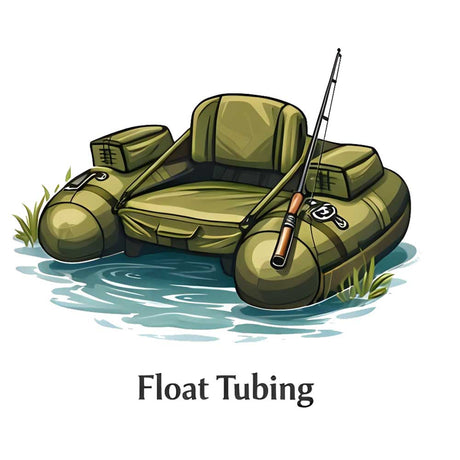
Float Tubes
Float tubes revolutionise stillwater fishing by providing access beyond shore casting range. You reach inaccessible water, fish parallel to weedbeds and target channels where trophy fish hold. Low profile maintains stealth. The Horizon Trout Stalker incorporates decades of design refinement.
Look for inflatable air seats and backrests providing comfort whilst avoiding thermal transfer. Critical features include heavy-duty construction (420D nylon top/sides, 500D PVC bottom), heat seam-sealed urethane bladders and cargo pockets. An anchor system proves essential for fishing structure in wind. Temperature changes cause air expansion/contraction—under-inflate by 5-10% on warming mornings, release 20% during hot midday, over-inflate by 5-10% on cooling evenings. Always store completely deflated. For complete float tubing guidance, see our Stillwater Gear Guide.
Recommended Features:
- V-shaped hull
- Inflatable air seat and backrest (NOT foam)
- Heavy-duty construction (420D+ nylon, 500D+ PVC bottom)
- Heat seam-sealed urethane bladders
- Multiple storage pockets
- Built-in rod holders and D-rings
- Complete setup: Float tube, fins, booties, anchor system

 Regular price R 2,450.00 ZARUnit price /UnavailableVery low stock (1 unit)

Horizon Tactical Freshwater Fly Rod
Regular price From R 5,450.00 ZARUnit price /Unavailable
 Regular price R 6,400.00 ZARUnit price /Unavailable


 Regular price From R 2,200.00 ZARUnit price /Unavailable


 Regular price R 8,590.00 ZARUnit price /Unavailable

 Regular price R 6,490.00 ZARUnit price /Unavailable


Scientific Anglers Sonar Seamless Density
Regular price R 1,820.00 ZARUnit price /Unavailable

Scientific Anglers Frequency Boost
Regular price R 1,230.00 ZARUnit price /Unavailable
Scientific Anglers Absolute Leader
Regular price R 160.00 ZARUnit price /Unavailable
TroutHunter Fluorocarbon Tippet
Regular price R 550.00 ZARUnit price /Unavailable

Scientific Anglers Tippet Rings
Regular price R 230.00 ZARUnit price /Unavailable
 Regular price R 2,600.00 ZARUnit price /Unavailable
 Regular price R 1,500.00 ZARUnit price /Unavailable
 Regular price R 4,150.00 ZARUnit price /Unavailable
 Sold out
Fishpond Canyon Creek Chest Pack
Regular price R 2,260.00 ZARUnit price /Unavailable

Fishpond Switchback Belt System 2.0
Regular price R 3,250.00 ZARUnit price /UnavailableLow stock (2 units)


Horizon Guide Breathable Zip Waders
Regular price R 5,850.00 ZARUnit price /Unavailable

Simms Freestone Wading Boot - Rubber
Regular price R 6,090.00 ZARUnit price /Unavailable
 Regular price R 1,850.00 ZARUnit price /Unavailable
 Regular price R 350.00 ZARUnit price /Unavailable
 Regular price R 200.00 ZARUnit price /Unavailable
 Regular price R 250.00 ZARUnit price /Unavailable
 Regular price R 50.00 ZARUnit price /Unavailable

 Regular price R 130.00 ZARUnit price /Unavailable

Gold Ribbed Hares Ear Rubber Legs - 3 pack
Regular price R 40.00 ZARUnit price /Unavailable

 Regular price R 350.00 ZARUnit price /Unavailable
 Regular price R 1,450.00 ZARUnit price /Unavailable




Frequently Asked Questions
What rod weight do I need for trout fly fishing?
What rod weight do I need for trout fly fishing?
A 5-weight, 9-foot rod provides versatility across both streams and stillwaters. For dedicated stream fishing, 3-4 weights offer delicate presentations. Stillwater anglers benefit from 5-6 weights for distance casting and handling larger fish. Fast-action rods excel in stillwater, medium-fast suits streams.
Where can I fly fish for trout in South Africa?
Where can I fly fish for trout in South Africa?
Rhodes in the Eastern Cape provides Wild Trout Association waters. The Western Cape features streams near Stellenbosch managed by the Cape Piscatorial Society. KwaZulu-Natal's Drakensberg offers high-altitude streams and dams. Mpumalanga's "Trout Triangle" around Dullstroom & ydenberg hosts numerous stillwaters. There is trout fishing near Clarence. And the KZN Midlands, near Nottingham Road, has numerous venues
What flies work best for South African trout?
What flies work best for South African trout?
For streams, carry DDD, RABs, Rubber Leg Stimulators, Parachute Adams, ZAK nymphs and PTNs in sizes 12-20. For stillwater, Woolly Buggers (olive, black, orange in sizes 4-12), Red-eyed Damsel patterns, Papa Roach dragonflies and buzzers form the foundation. Consult local fly shops for seasonal recommendations.
What is the best time of year to fly fish for trout?
What is the best time of year to fly fish for trout?
Autumn (March-May) and spring (September-October) deliver peak conditions. Many stillwaters remain open year-round. Winter closures (June-August) protect spawning fish on Drakensberg and Western Cape rivers. Summer provides excellent dry fly opportunities during morning and evening rises.
Do I need a special reel for trout fly fishing?
Do I need a special reel for trout fly fishing?
A quality reel with smooth drag suffices. Large arbor designs retrieve line faster. Match reel size to rod weight—3/4 for streams, 5/6 for stillwater. Sealed drags protect against moisture. Budget R1,000-R7,000 for reliable performance. Stillwater demands stronger drags (2-3kg) than streams (1-2kg).
Can beginners catch trout on fly gear?
Can beginners catch trout on fly gear?
Yes, South African trout fishing accommodates beginners well. Stillwaters offer forgiving environments with actively hunting fish. Commercial venues stock regularly. Streams present moderate challenges—start on wider waters with good populations. Hiring a guide accelerates learning significantly. Begin with versatile 5-weight outfits and floating lines.
What leader and tippet should I use for trout?
What leader and tippet should I use for trout?
Use 9-12 foot tapered leaders for both streams and stillwaters. For streams, 5X tippet (2.5kg) works well, lighter to 6X-7X for spooky fish. Stillwater allows 3X-4X (2-4kg). Use nylon for dry flies (shock absorption), fluorocarbon for subsurface (low visibility, sink rate). Both materials offer equal abrasion resistance.
Should I wet wade or use waders for trout fishing?
Should I wet wade or use waders for trout fishing?
Wet wade October through May with specialised boots and neoprene socks. June through early October, particularly in highland venues, demands breathable chest waders. Stockingfoot waders paired with ruber sole wading boots, work best.
Do I need a float tube for stillwater trout fishing?
Do I need a float tube for stillwater trout fishing?
Float tubes dramatically improve stillwater success by providing access beyond shore range. They allow fishing parallel to weedbeds where trout cruise. You can target specific structure with precision whilst maintaining low profile. Combined with anchor systems, you hold position in wind. Transformative for serious stillwater pursuit.
What makes the Drakensberg good for trout fishing?
What makes the Drakensberg good for trout fishing?
The Drakensberg provides pristine high-altitude streams and dams with exceptional water quality. Cool temperatures suit trout perfectly. Crystal-clear water demands technical presentations but allows sight-fishing. Spectacular scenery enhances experiences. Both stream and stillwater options exist within short distances, with year-round opportunities.